Transforming Deal Creation into an AI-Guided Sales Workflow
Overview
Sales reps at Groupon relied on a fragmented workflow to create deals—switching between multiple tools, manually writing content, and validating pricing through separate systems. While functional, the process was slow, inconsistent, and heavily dependent on individual experience.
AI Deal Generator (AIDG) was introduced as an internal tool to streamline this workflow. By leveraging Salesforce as a single source of truth and combining it with AI-driven generation, the goal was to enable reps to create high-quality deal previews in minutes, directly during client interactions.
The ambition was not only to speed up deal creation, but to make the process more structured, scalable, and accessible across different experience levels.
Client
Groupon
Timeline
2025
Tools used
Figma
Cursor
ChatGPT
NotebookLM
Miro
Tableau
Github
Vercel
Problem
Creating a deal required navigating across several tools, gathering information manually, and writing all content from scratch. This often took more than 30 minutes per deal, making it difficult to operate efficiently—especially during live calls with merchants.
The experience was inconsistent. More experienced reps could structure strong deals, while less experienced ones struggled with pricing, positioning, and formatting. There was no clear guidance on what makes a “good deal,” and validating decisions required additional effort outside the main workflow.
This fragmentation also affected negotiations. Reps lacked real-time insights into pricing, competition, or campaign context, which limited their ability to respond quickly and confidently during conversations with merchants.
My role
I joined the project during the early discovery phase and took ownership of the product design end-to-end. From that point, I was responsible for shaping the experience across the entire workflow—from initial input to final deal preview and submission.
The work required close collaboration with product managers, engineers, and multiple sales teams across regions. A significant part of the process involved mapping workflows not only within sales, but also across operations, content, finance, and merchant research teams.
This helped align the product with real-world processes and ensured the solution addressed the full complexity of the system.
Actions
The redesign focused on transforming a fragmented, manual process into a guided, AI-assisted workflow that supports reps throughout deal creation.
1. AI-generated deal creation
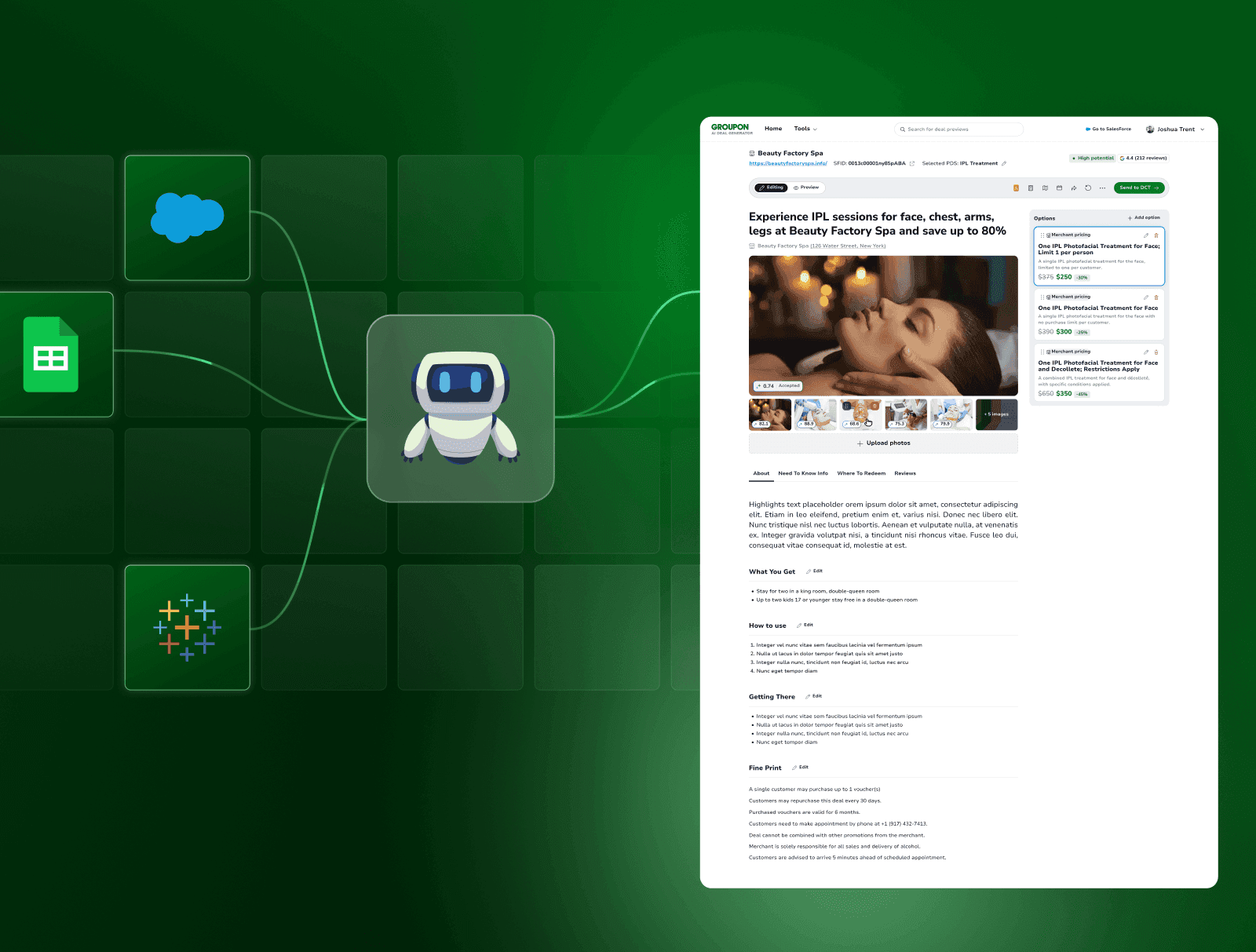
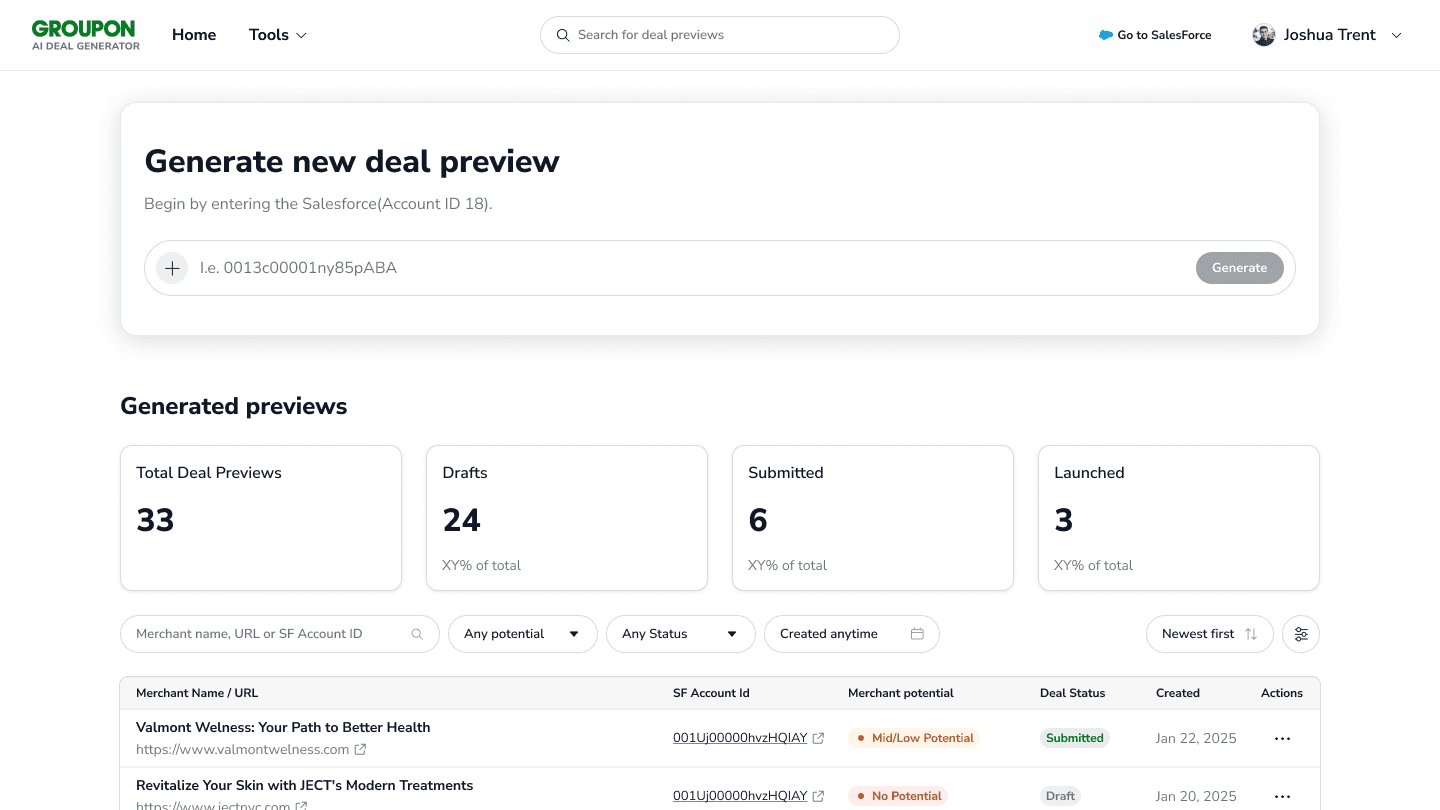
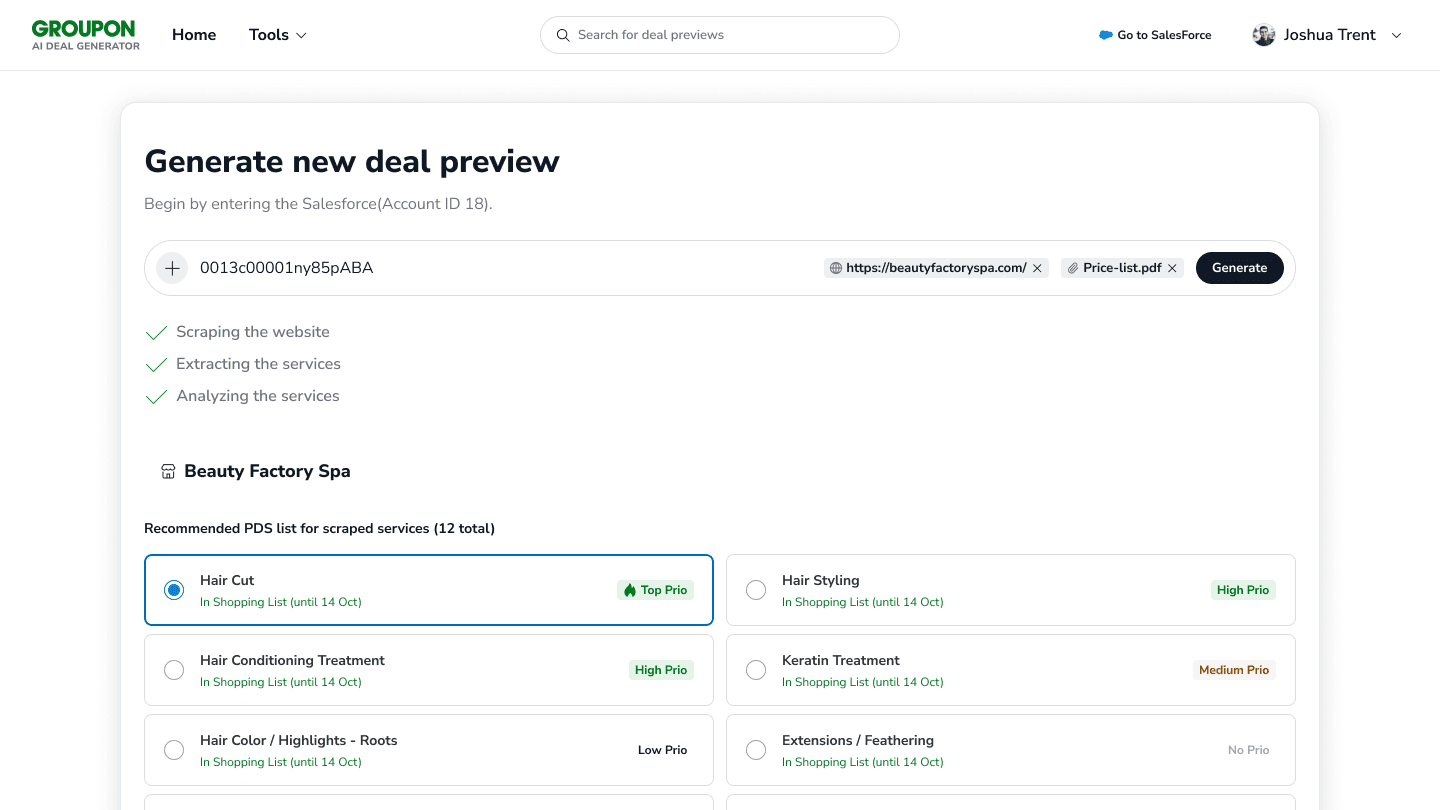
The flow begins with a Salesforce Account ID, which acts as the primary data source. Based on this input, the system fetches merchant data, recommends relevant deal categories, and generates a structured deal using predefined templates.
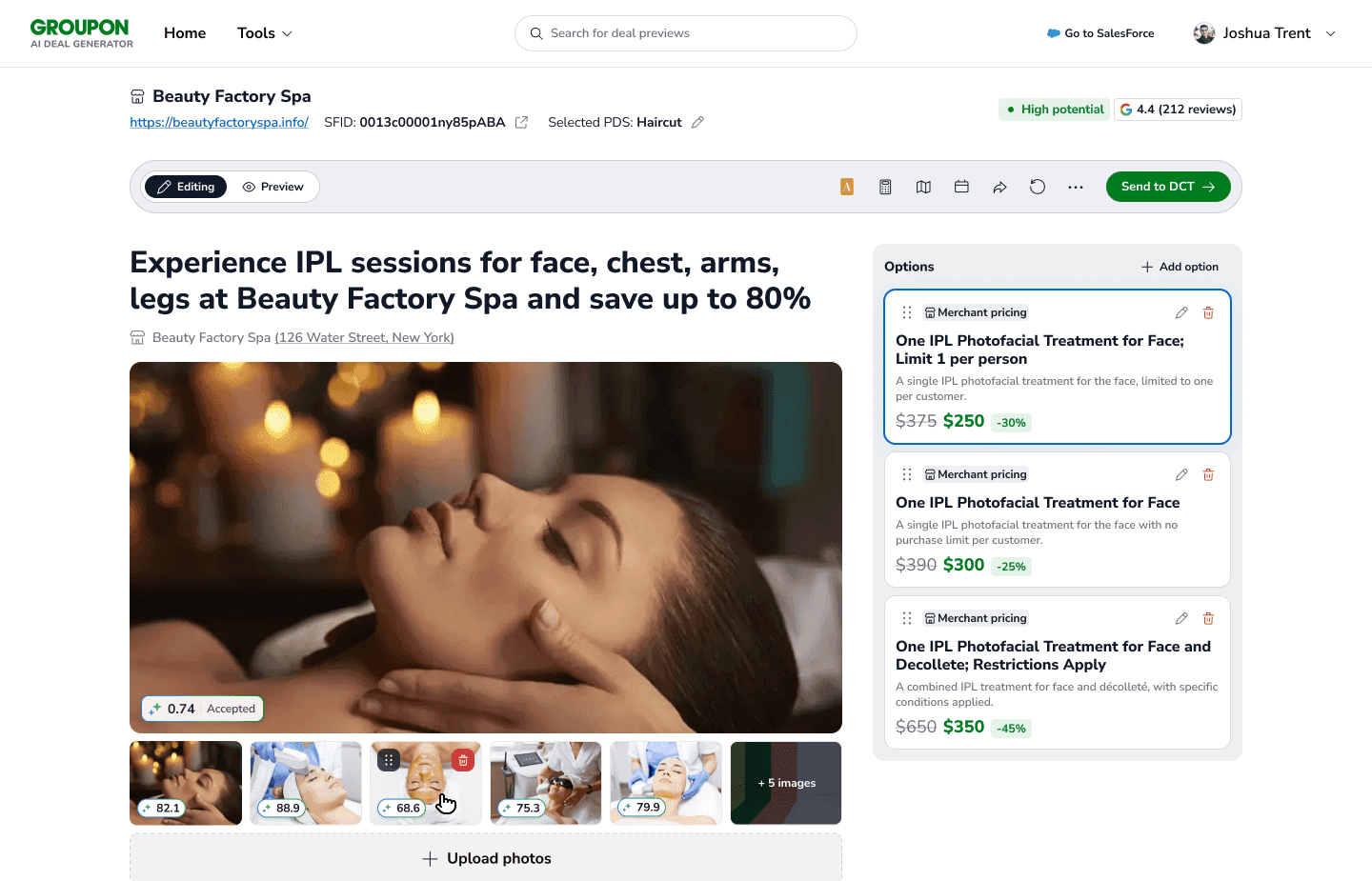
Instead of starting from a blank page, reps are presented with a ready-to-edit deal preview. This significantly reduces the time and effort required to create an initial version.
2. Guided decision-making
Rather than fully automating the process, the system was designed to support decision-making with contextual insights.
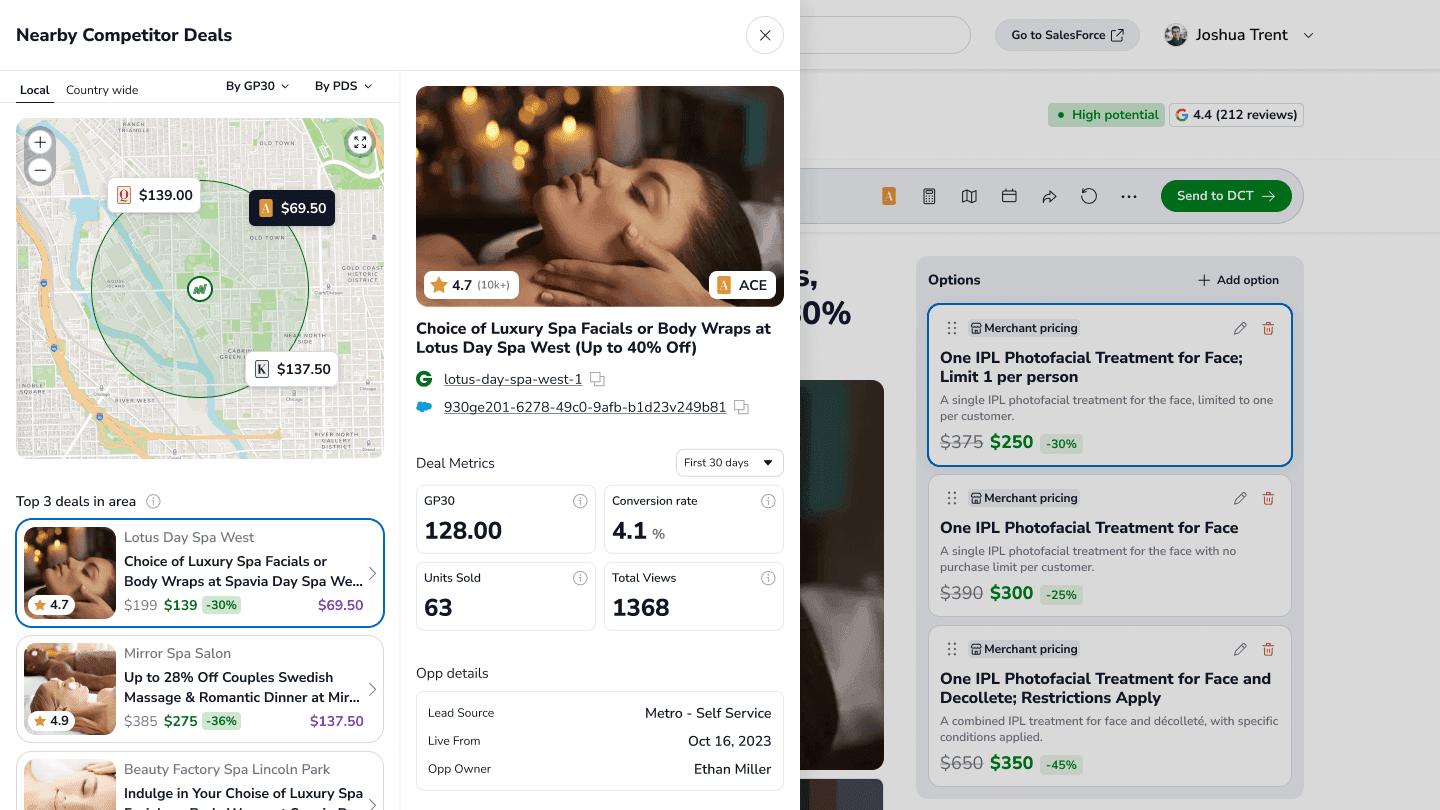
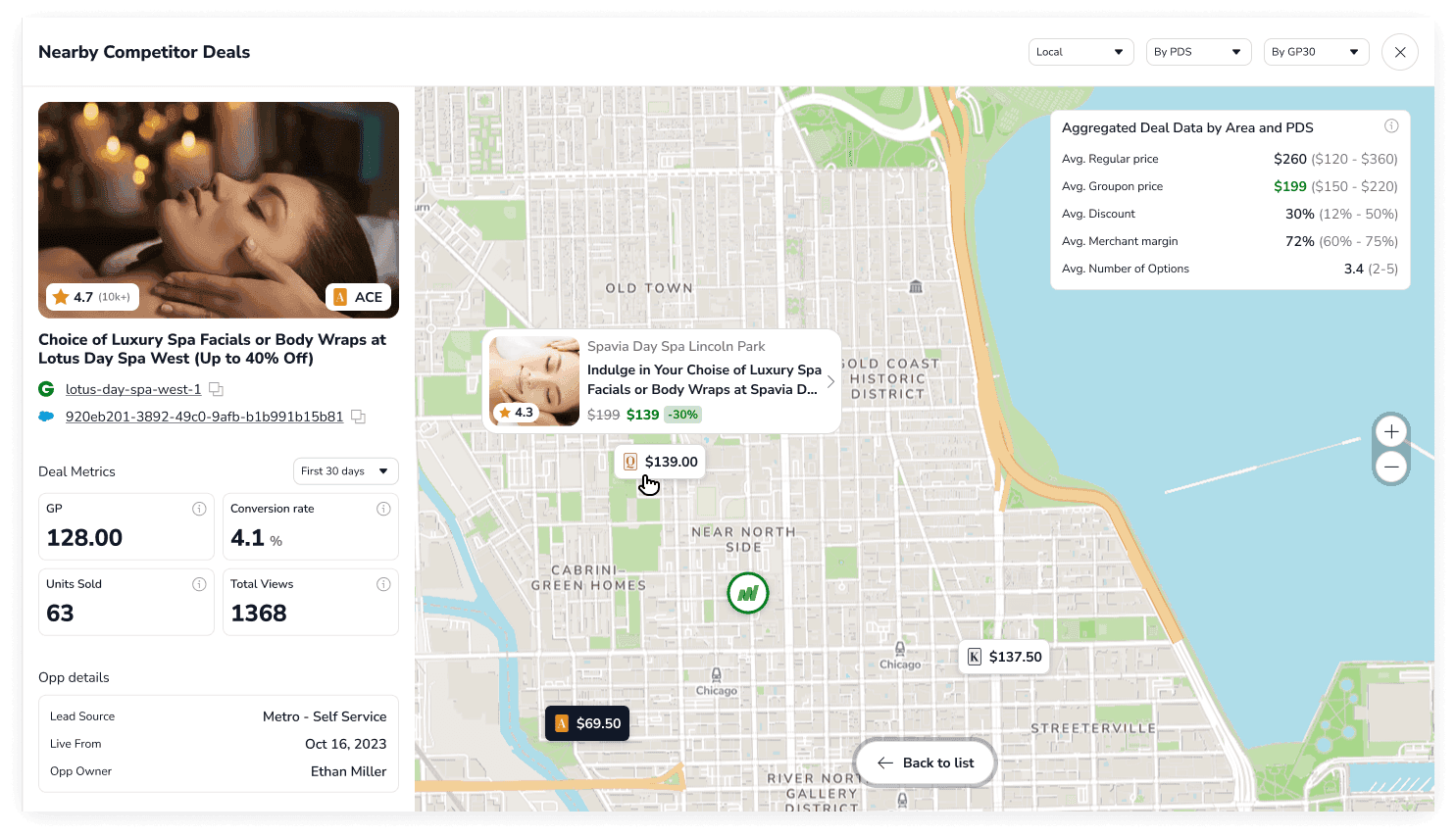
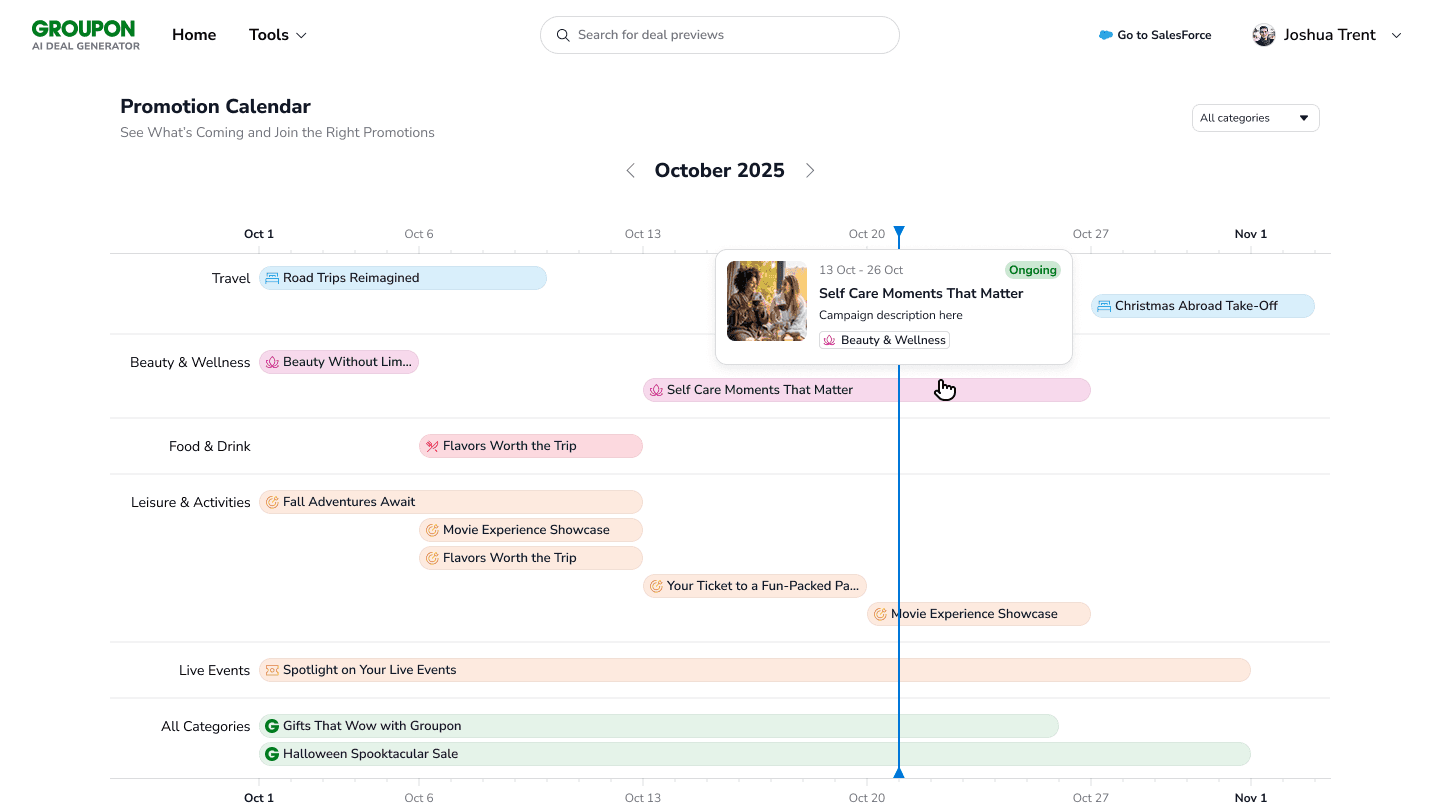
Reps receive recommendations based on internal priorities and market conditions, including suggested deal categories, competitive benchmarks, and campaign timing. A built-in deal scoring system provides additional feedback on expected performance, helping reps refine their offers.
This approach shifts the role of the tool from content generator to decision support system.
3. Real-time negotiation support
One of the key challenges was enabling reps to work effectively during live calls.
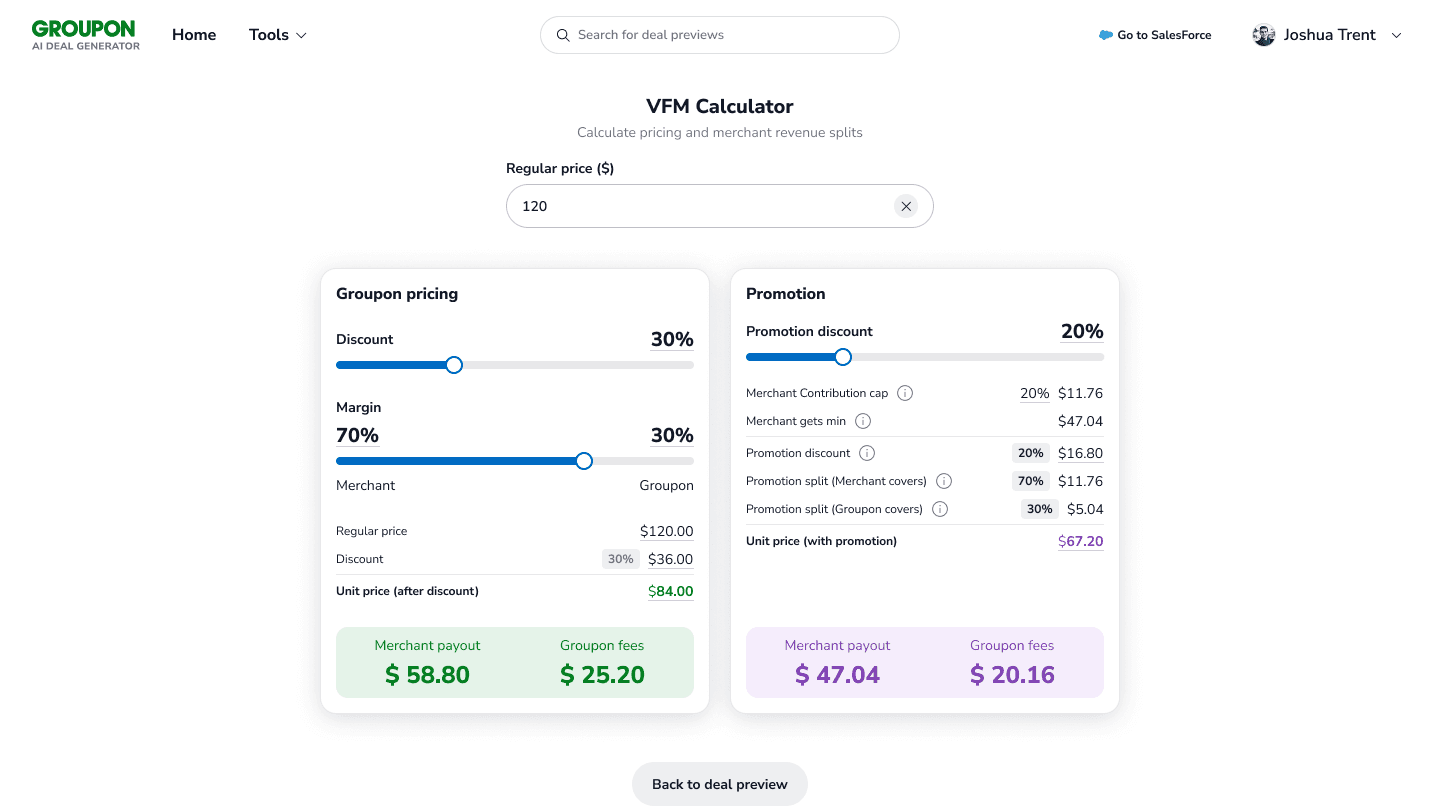
To address this, the experience includes tools that allow real-time adjustments. A pricing calculator helps reps instantly evaluate discounts, margins, and merchant payouts, while the editable preview allows them to modify content and structure on the fly.
In practice, many reps began preparing multiple deal variants before calls, using them as negotiation scenarios to engage merchants and accelerate decision-making.
4. AI-assisted content and validation
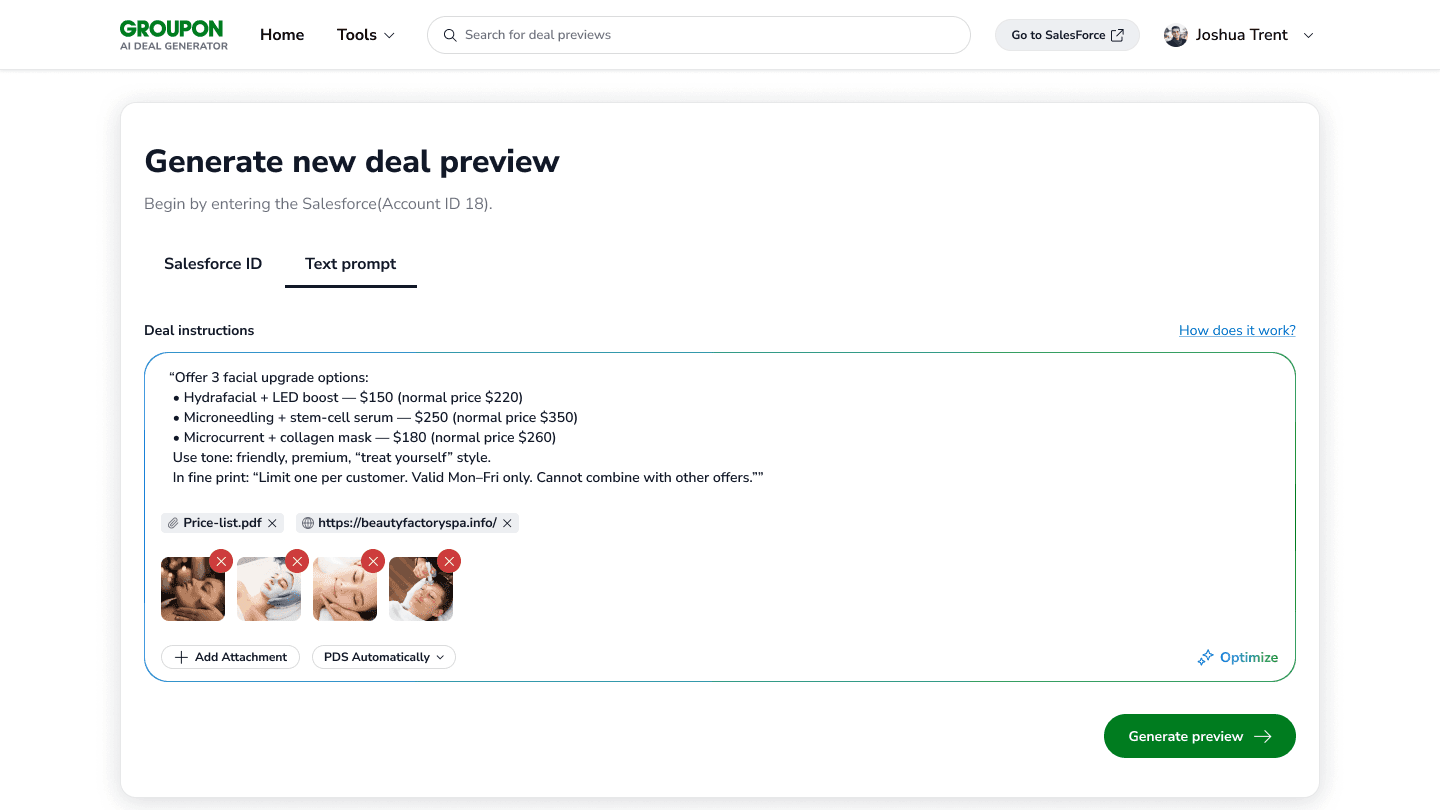
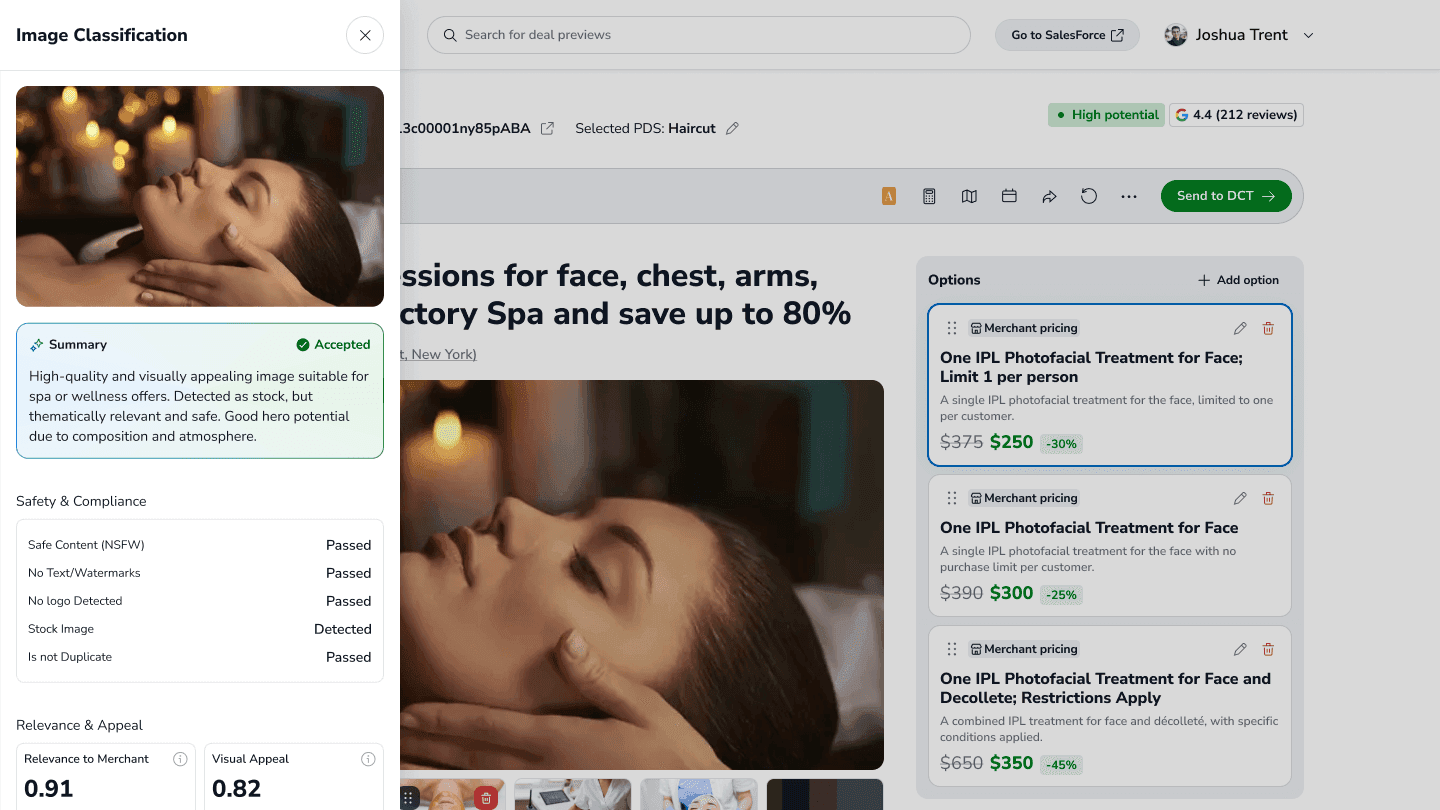
The system integrates data from merchant websites, extracting services, pricing, and images. AI is used to classify and filter visual content, ensuring only relevant and compliant images are used.
This reduces manual work for content and vetting teams while maintaining a consistent quality baseline across deals.
5. Merchant collaboration through live preview
Each generated deal can be shared via a unique preview link, allowing merchants to view the offer exactly as it would appear once published.
This introduced a more collaborative dynamic to the sales process. Reps could walk merchants through the deal in real time, make adjustments during the conversation, and reach alignment faster.
This feature became one of the strongest drivers of improved conversion.
6. Unified workflow across systems
AIDG consolidates multiple tools and data sources into a single interface, including Salesforce, internal data engines, analytics, and the final deal creation system.
By removing the need to switch between tools, reps can stay focused on the conversation and the deal itself, rather than the process.
Results
Speed & Efficiency
Deal creation reduced from 30+ min → 5–15 min
Up to ~80% faster in ideal scenarios
Time to Close
~40–50% faster deal closure
Sales Productivity
BD reps saw ~50% improvement
AIDG users outperformed non-users
Adoption
~50% of reps at peak adoption
Strongest usage among Business Development reps (volume-driven roles)
Quality
Deal quality scores remained stable
👉 Key outcome:
Maintained quality while significantly increasing speed and volume
Conversion Impact
Merchant preview feature significantly improved close rates
Better engagement during live calls
Learnings
Designing AIDG highlighted the gap between building AI-powered features and delivering a reliable product experience. Early versions of the system required significant manual adjustments, which reduced trust and slowed adoption. Over time, it became clear that consistency and reliability are more critical than the sophistication of the output.
Performance also proved to be a key factor. Even strong results lost value when generation times reached several minutes, particularly in live sales scenarios where responsiveness is essential.
A major takeaway was the importance of deeply understanding operational workflows. Mapping processes across multiple teams revealed dependencies and constraints that were not visible at the surface level. This insight was crucial in shaping a solution that fits into real-world usage.
The project also reinforced that adoption is not purely a product problem. Some users resisted the tool due to established habits or skepticism toward AI, regardless of its capabilities.
Finally, the pace of delivery had a direct impact on perception. Frequent releases combined with unresolved issues created friction, suggesting that prioritizing stability over speed would have led to stronger long-term adoption.
Transforming Deal Creation into an AI-Guided Sales Workflow
Overview
Sales reps at Groupon relied on a fragmented workflow to create deals—switching between multiple tools, manually writing content, and validating pricing through separate systems. While functional, the process was slow, inconsistent, and heavily dependent on individual experience.
AI Deal Generator (AIDG) was introduced as an internal tool to streamline this workflow. By leveraging Salesforce as a single source of truth and combining it with AI-driven generation, the goal was to enable reps to create high-quality deal previews in minutes, directly during client interactions.
The ambition was not only to speed up deal creation, but to make the process more structured, scalable, and accessible across different experience levels.
Client
Groupon
Timeline
2025
Tools used
Figma
Cursor
ChatGPT
NotebookLM
Miro
Tableau
Github
Vercel
Problem
Creating a deal required navigating across several tools, gathering information manually, and writing all content from scratch. This often took more than 30 minutes per deal, making it difficult to operate efficiently—especially during live calls with merchants.
The experience was inconsistent. More experienced reps could structure strong deals, while less experienced ones struggled with pricing, positioning, and formatting. There was no clear guidance on what makes a “good deal,” and validating decisions required additional effort outside the main workflow.
This fragmentation also affected negotiations. Reps lacked real-time insights into pricing, competition, or campaign context, which limited their ability to respond quickly and confidently during conversations with merchants.
My role
I joined the project during the early discovery phase and took ownership of the product design end-to-end. From that point, I was responsible for shaping the experience across the entire workflow—from initial input to final deal preview and submission.
The work required close collaboration with product managers, engineers, and multiple sales teams across regions. A significant part of the process involved mapping workflows not only within sales, but also across operations, content, finance, and merchant research teams.
This helped align the product with real-world processes and ensured the solution addressed the full complexity of the system.
Actions
The redesign focused on transforming a fragmented, manual process into a guided, AI-assisted workflow that supports reps throughout deal creation.
1. AI-generated deal creation
The flow begins with a Salesforce Account ID, which acts as the primary data source. Based on this input, the system fetches merchant data, recommends relevant deal categories, and generates a structured deal using predefined templates.
Instead of starting from a blank page, reps are presented with a ready-to-edit deal preview. This significantly reduces the time and effort required to create an initial version.
2. Guided decision-making
Rather than fully automating the process, the system was designed to support decision-making with contextual insights.
Reps receive recommendations based on internal priorities and market conditions, including suggested deal categories, competitive benchmarks, and campaign timing. A built-in deal scoring system provides additional feedback on expected performance, helping reps refine their offers.
This approach shifts the role of the tool from content generator to decision support system.
3. Real-time negotiation support
One of the key challenges was enabling reps to work effectively during live calls.
To address this, the experience includes tools that allow real-time adjustments. A pricing calculator helps reps instantly evaluate discounts, margins, and merchant payouts, while the editable preview allows them to modify content and structure on the fly.
In practice, many reps began preparing multiple deal variants before calls, using them as negotiation scenarios to engage merchants and accelerate decision-making.
4. AI-assisted content and validation
The system integrates data from merchant websites, extracting services, pricing, and images. AI is used to classify and filter visual content, ensuring only relevant and compliant images are used.
This reduces manual work for content and vetting teams while maintaining a consistent quality baseline across deals.
5. Merchant collaboration through live preview
Each generated deal can be shared via a unique preview link, allowing merchants to view the offer exactly as it would appear once published.
This introduced a more collaborative dynamic to the sales process. Reps could walk merchants through the deal in real time, make adjustments during the conversation, and reach alignment faster.
This feature became one of the strongest drivers of improved conversion.
6. Unified workflow across systems
AIDG consolidates multiple tools and data sources into a single interface, including Salesforce, internal data engines, analytics, and the final deal creation system.
By removing the need to switch between tools, reps can stay focused on the conversation and the deal itself, rather than the process.
Results
Speed & Efficiency
Deal creation reduced from 30+ min → 5–15 min
Up to ~80% faster in ideal scenarios
Time to Close
~40–50% faster deal closure
Sales Productivity
BD reps saw ~50% improvement
AIDG users outperformed non-users
Adoption
~50% of reps at peak adoption
Strongest usage among Business Development reps (volume-driven roles)
Quality
Deal quality scores remained stable
👉 Key outcome:
Maintained quality while significantly increasing speed and volume
Conversion Impact
Merchant preview feature significantly improved close rates
Better engagement during live calls
Learnings
Designing AIDG highlighted the gap between building AI-powered features and delivering a reliable product experience. Early versions of the system required significant manual adjustments, which reduced trust and slowed adoption. Over time, it became clear that consistency and reliability are more critical than the sophistication of the output.
Performance also proved to be a key factor. Even strong results lost value when generation times reached several minutes, particularly in live sales scenarios where responsiveness is essential.
A major takeaway was the importance of deeply understanding operational workflows. Mapping processes across multiple teams revealed dependencies and constraints that were not visible at the surface level. This insight was crucial in shaping a solution that fits into real-world usage.
The project also reinforced that adoption is not purely a product problem. Some users resisted the tool due to established habits or skepticism toward AI, regardless of its capabilities.
Finally, the pace of delivery had a direct impact on perception. Frequent releases combined with unresolved issues created friction, suggesting that prioritizing stability over speed would have led to stronger long-term adoption.
Transforming Deal Creation into an AI-Guided Sales Workflow
Overview
Sales reps at Groupon relied on a fragmented workflow to create deals—switching between multiple tools, manually writing content, and validating pricing through separate systems. While functional, the process was slow, inconsistent, and heavily dependent on individual experience.
AI Deal Generator (AIDG) was introduced as an internal tool to streamline this workflow. By leveraging Salesforce as a single source of truth and combining it with AI-driven generation, the goal was to enable reps to create high-quality deal previews in minutes, directly during client interactions.
The ambition was not only to speed up deal creation, but to make the process more structured, scalable, and accessible across different experience levels.
Client
Groupon
Timeline
2025
Tools used
Figma
Cursor
ChatGPT
NotebookLM
Miro
Tableau
Github
Vercel
Problem
Creating a deal required navigating across several tools, gathering information manually, and writing all content from scratch. This often took more than 30 minutes per deal, making it difficult to operate efficiently—especially during live calls with merchants.
The experience was inconsistent. More experienced reps could structure strong deals, while less experienced ones struggled with pricing, positioning, and formatting. There was no clear guidance on what makes a “good deal,” and validating decisions required additional effort outside the main workflow.
This fragmentation also affected negotiations. Reps lacked real-time insights into pricing, competition, or campaign context, which limited their ability to respond quickly and confidently during conversations with merchants.
My role
I joined the project during the early discovery phase and took ownership of the product design end-to-end. From that point, I was responsible for shaping the experience across the entire workflow—from initial input to final deal preview and submission.
The work required close collaboration with product managers, engineers, and multiple sales teams across regions. A significant part of the process involved mapping workflows not only within sales, but also across operations, content, finance, and merchant research teams.
This helped align the product with real-world processes and ensured the solution addressed the full complexity of the system.
Actions
The redesign focused on transforming a fragmented, manual process into a guided, AI-assisted workflow that supports reps throughout deal creation.
1. AI-generated deal creation
The flow begins with a Salesforce Account ID, which acts as the primary data source. Based on this input, the system fetches merchant data, recommends relevant deal categories, and generates a structured deal using predefined templates.
Instead of starting from a blank page, reps are presented with a ready-to-edit deal preview. This significantly reduces the time and effort required to create an initial version.
2. Guided decision-making
Rather than fully automating the process, the system was designed to support decision-making with contextual insights.
Reps receive recommendations based on internal priorities and market conditions, including suggested deal categories, competitive benchmarks, and campaign timing. A built-in deal scoring system provides additional feedback on expected performance, helping reps refine their offers.
This approach shifts the role of the tool from content generator to decision support system.
3. Real-time negotiation support
One of the key challenges was enabling reps to work effectively during live calls.
To address this, the experience includes tools that allow real-time adjustments. A pricing calculator helps reps instantly evaluate discounts, margins, and merchant payouts, while the editable preview allows them to modify content and structure on the fly.
In practice, many reps began preparing multiple deal variants before calls, using them as negotiation scenarios to engage merchants and accelerate decision-making.
4. AI-assisted content and validation
The system integrates data from merchant websites, extracting services, pricing, and images. AI is used to classify and filter visual content, ensuring only relevant and compliant images are used.
This reduces manual work for content and vetting teams while maintaining a consistent quality baseline across deals.
5. Merchant collaboration through live preview
Each generated deal can be shared via a unique preview link, allowing merchants to view the offer exactly as it would appear once published.
This introduced a more collaborative dynamic to the sales process. Reps could walk merchants through the deal in real time, make adjustments during the conversation, and reach alignment faster.
This feature became one of the strongest drivers of improved conversion.
6. Unified workflow across systems
AIDG consolidates multiple tools and data sources into a single interface, including Salesforce, internal data engines, analytics, and the final deal creation system.
By removing the need to switch between tools, reps can stay focused on the conversation and the deal itself, rather than the process.
Results
Speed & Efficiency
Deal creation reduced from 30+ min → 5–15 min
Up to ~80% faster in ideal scenarios
Time to Close
~40–50% faster deal closure
Sales Productivity
BD reps saw ~50% improvement
AIDG users outperformed non-users
Adoption
~50% of reps at peak adoption
Strongest usage among Business Development reps (volume-driven roles)
Quality
Deal quality scores remained stable
👉 Key outcome:
Maintained quality while significantly increasing speed and volume
Conversion Impact
Merchant preview feature significantly improved close rates
Better engagement during live calls
Learnings
Designing AIDG highlighted the gap between building AI-powered features and delivering a reliable product experience. Early versions of the system required significant manual adjustments, which reduced trust and slowed adoption. Over time, it became clear that consistency and reliability are more critical than the sophistication of the output.
Performance also proved to be a key factor. Even strong results lost value when generation times reached several minutes, particularly in live sales scenarios where responsiveness is essential.
A major takeaway was the importance of deeply understanding operational workflows. Mapping processes across multiple teams revealed dependencies and constraints that were not visible at the surface level. This insight was crucial in shaping a solution that fits into real-world usage.
The project also reinforced that adoption is not purely a product problem. Some users resisted the tool due to established habits or skepticism toward AI, regardless of its capabilities.
Finally, the pace of delivery had a direct impact on perception. Frequent releases combined with unresolved issues created friction, suggesting that prioritizing stability over speed would have led to stronger long-term adoption.