Merchant Acquisition Landing Page Redesign
Overview
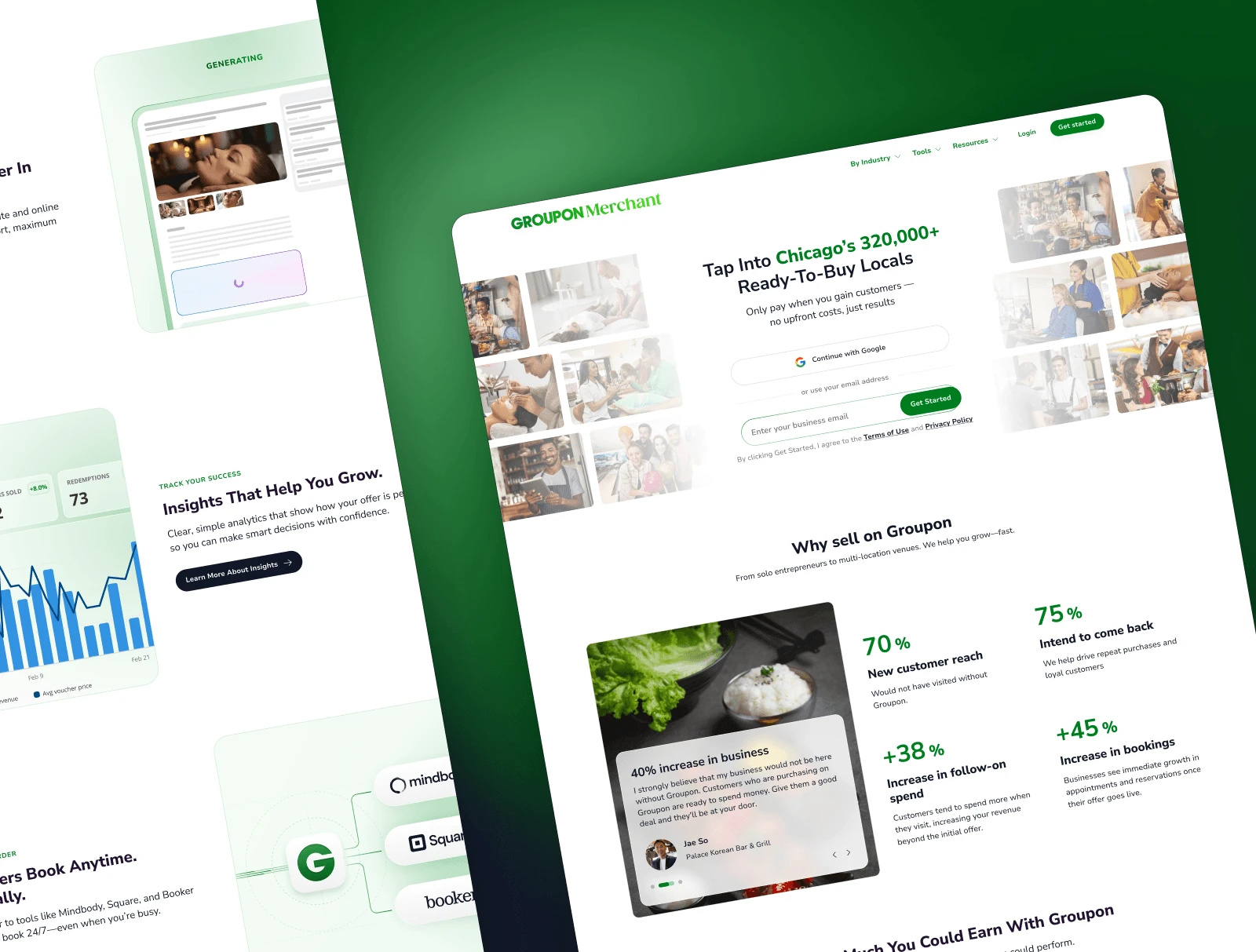
Groupon’s merchant acquisition landing page is the main entry point for businesses interested in selling on the platform. The page attracts hundreds of thousands of visitors annually, yet conversion rates had stagnated.
The existing page was built on an outdated CMS and required merchants to provide extensive business details before clearly understanding the value of joining the marketplace.
As part of a broader effort to improve the merchant onboarding experience, I redesigned the landing page to reduce friction, communicate value earlier, and improve signup conversion.
Client
Groupon
Tools used
Figma
Cursor
ChatGPT
NotebookLM
Google Analytics
Tableau

Clarity
Jitter
Problem
The original merchant landing page suffered from several structural issues that negatively impacted conversion.
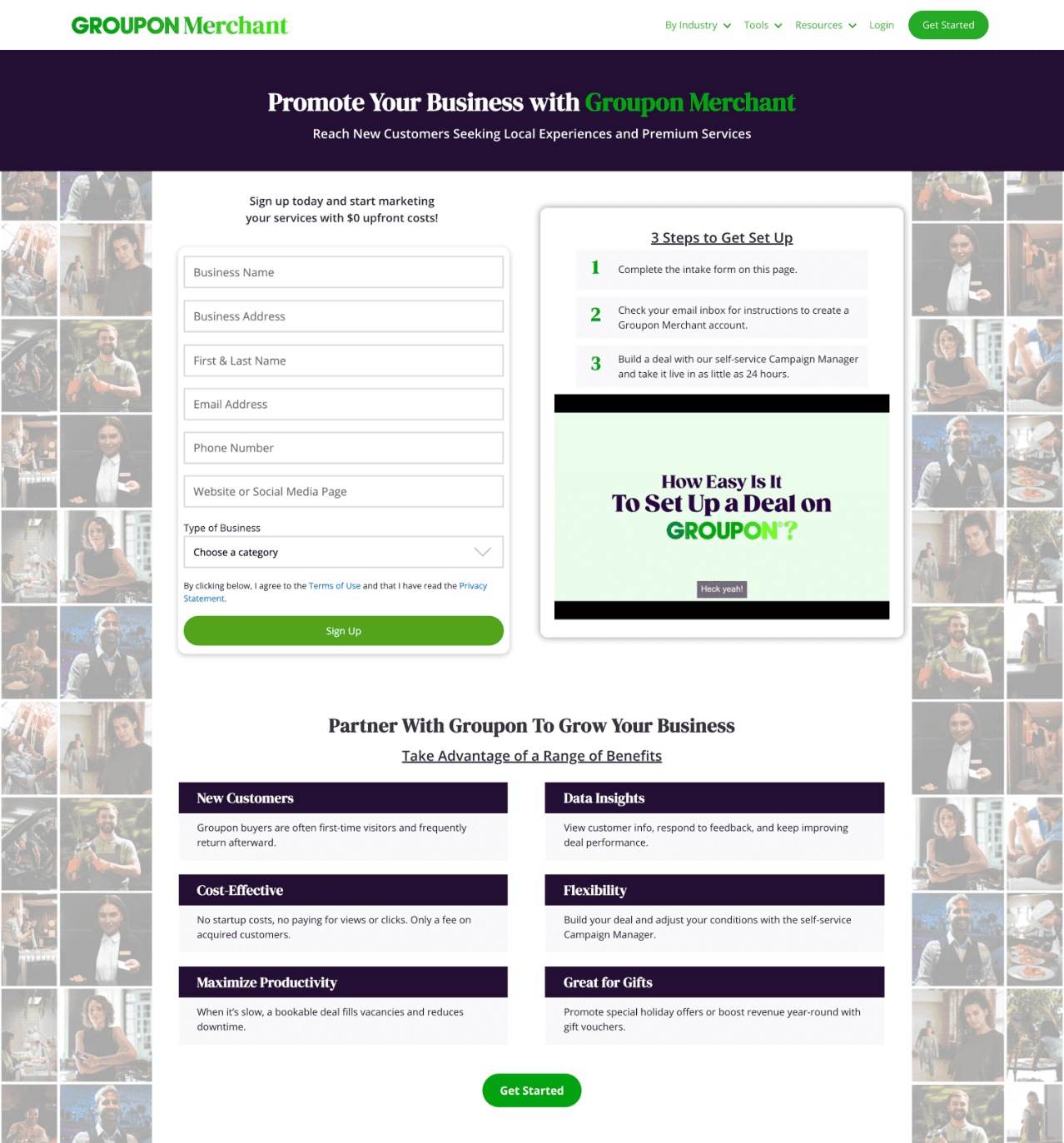
The hero section asked merchants to complete a long form before explaining the benefits of joining Groupon. Combined with heavy visuals and multiple competing messages, this created unnecessary cognitive load.
Internal analysis revealed additional friction:
generic value proposition
high commitment required early in the flow
outdated visual design
limited trust signals above the fold
The page was attracting traffic, but many merchants hesitated to begin the signup process.
My role
I led the UX and UI redesign of the merchant acquisition landing page.
My responsibilities included:
analyzing 50 competitor onboarding landing pages
running funnel analysis with internal stakeholders
designing the full page structure and UI
defining conversion hypotheses for A/B testing
writing and refining UX copy and messaging
building interactive prototypes
supporting engineering with HTML, CSS and JS components
monitoring performance during the A/B test experiment
The landing page redesign was part of a larger initiative to improve merchant onboarding, though this case study focuses specifically on the acquisition page.
Actions
1. Competitor Analysis
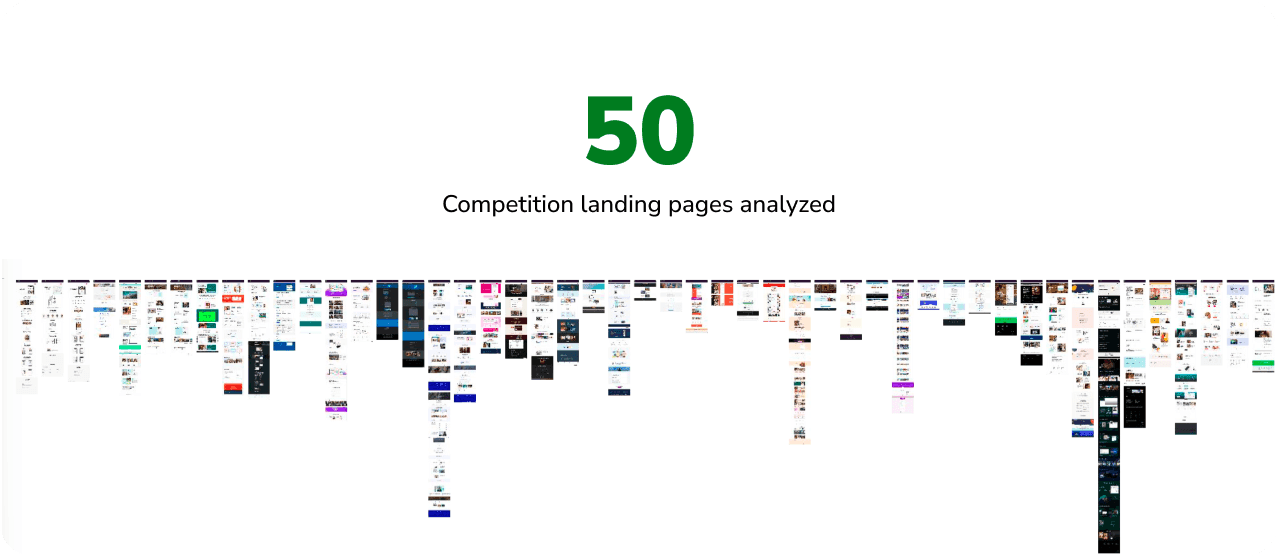
To understand best practices, I analyzed 50 marketplace landing pages including Airbnb, Booking, Square, Fresha and Treatwell.
Several patterns emerged:
strong value proposition above the fold
quantified benefits and social proof
low-friction entry before collecting detailed information
tools that visualize potential value
These insights informed the new page structure.
2. Conversion-Focused Layout
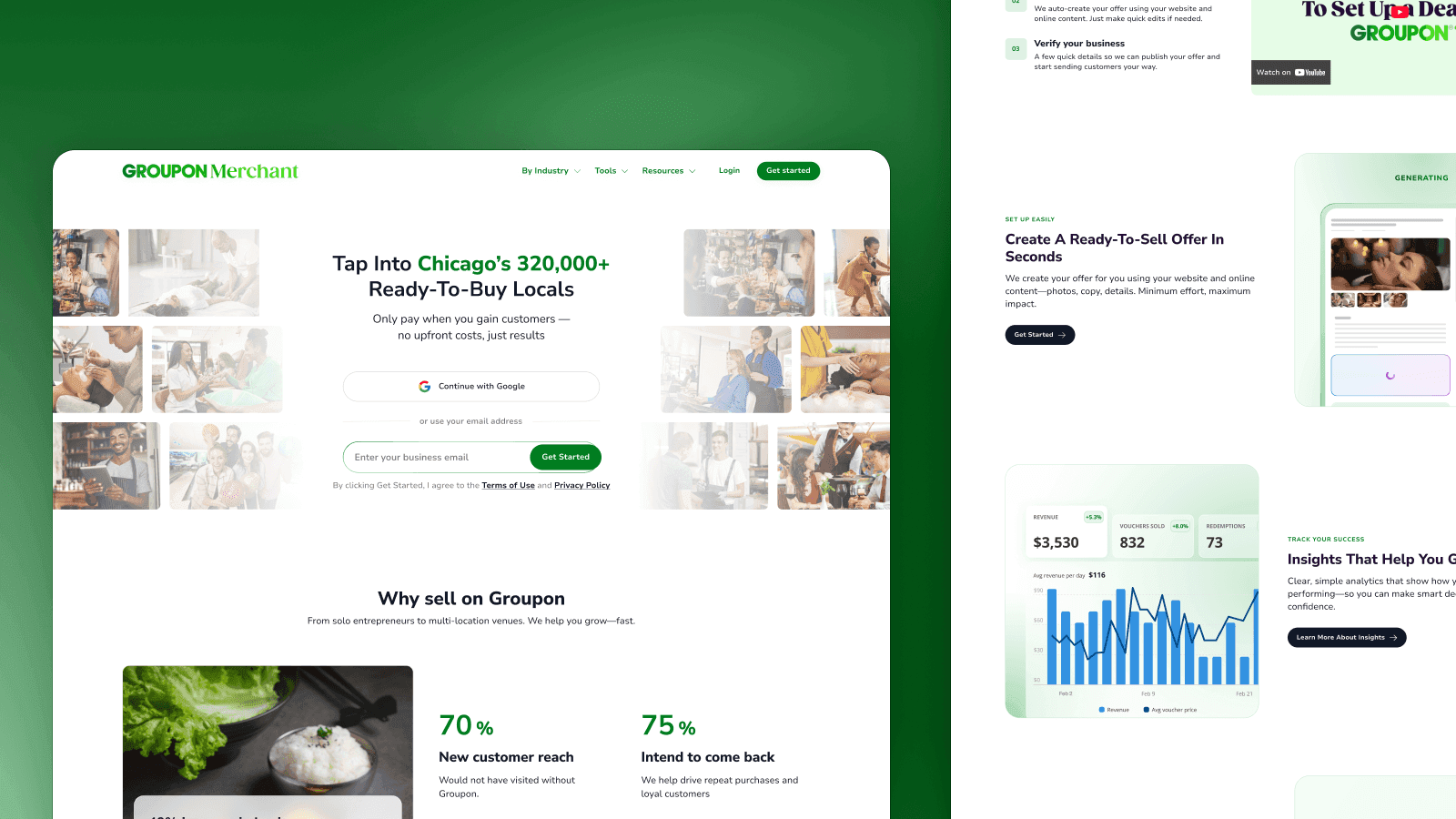
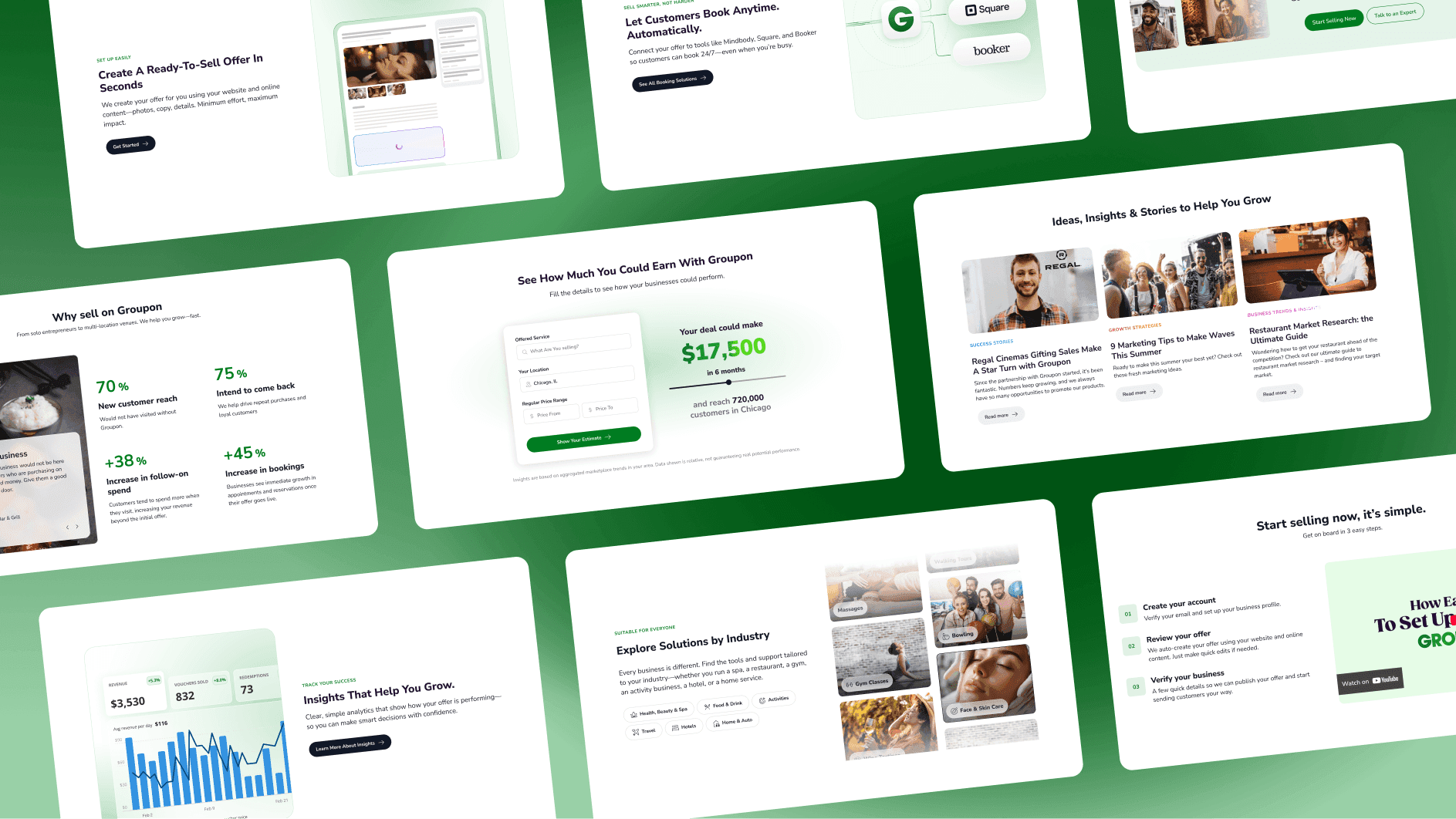
The redesign prioritized clarity and motivation.
Key improvements included:
simplified hero section
centered primary action
clear explanation of how Groupon works
stronger trust signals and merchant proof
product-led sections highlighting tools and integrations
The goal was to communicate value before commitment.
3. Data-Driven Validation
The new landing page was tested through an A/B experiment.
Traffic was initially split across 20% of visitors, with the control group seeing the original page and the treatment group seeing the redesign.
Performance was monitored weekly through analytics dashboards to validate improvements.
Results
The redesigned landing page delivered a measurable improvement in merchant acquisition performance.
Key outcome:
~28% increase in signup conversion rate
Results remained consistent across desktop and mobile traffic.
Beyond conversion improvements, the redesign also created a clearer and more scalable foundation for the broader onboarding experience.

Learnings
This project reinforced several important lessons about designing high-converting B2B landing pages.
Lead with value
Merchants were more willing to start the signup process once the benefits were clearly communicated.
Reduce friction early
Asking for too much information too soon creates hesitation.
Trust signals matter
Statistics, success stories and integrations help merchants feel confident joining the platform.
The redesign showed that even relatively small UX changes in the acquisition layer can have a significant impact on overall funnel performance.
Full frame

Merchant Acquisition Landing Page Redesign
Overview
Groupon’s merchant acquisition landing page is the main entry point for businesses interested in selling on the platform. The page attracts hundreds of thousands of visitors annually, yet conversion rates had stagnated.
The existing page was built on an outdated CMS and required merchants to provide extensive business details before clearly understanding the value of joining the marketplace.
As part of a broader effort to improve the merchant onboarding experience, I redesigned the landing page to reduce friction, communicate value earlier, and improve signup conversion.
Client
Groupon
Tools used
Figma
Cursor
ChatGPT
NotebookLM
Google Analytics
Tableau
Clarity
Jitter
Problem
The original merchant landing page suffered from several structural issues that negatively impacted conversion.
The hero section asked merchants to complete a long form before explaining the benefits of joining Groupon. Combined with heavy visuals and multiple competing messages, this created unnecessary cognitive load.
Internal analysis revealed additional friction:
generic value proposition
high commitment required early in the flow
outdated visual design
limited trust signals above the fold
The page was attracting traffic, but many merchants hesitated to begin the signup process.
My role
I led the UX and UI redesign of the merchant acquisition landing page.
My responsibilities included:
analyzing 50 competitor onboarding landing pages
running funnel analysis with internal stakeholders
designing the full page structure and UI
defining conversion hypotheses for A/B testing
writing and refining UX copy and messaging
building interactive prototypes
supporting engineering with HTML, CSS and JS components
monitoring performance during the A/B test experiment
The landing page redesign was part of a larger initiative to improve merchant onboarding, though this case study focuses specifically on the acquisition page.
Actions
1. Competitor Analysis
To understand best practices, I analyzed 50 marketplace landing pages including Airbnb, Booking, Square, Fresha and Treatwell.
Several patterns emerged:
strong value proposition above the fold
quantified benefits and social proof
low-friction entry before collecting detailed information
tools that visualize potential value
These insights informed the new page structure.
2. Conversion-Focused Layout
The redesign prioritized clarity and motivation.
Key improvements included:
simplified hero section
centered primary action
clear explanation of how Groupon works
stronger trust signals and merchant proof
product-led sections highlighting tools and integrations
The goal was to communicate value before commitment.
3. Data-Driven Validation
The new landing page was tested through an A/B experiment.
Traffic was initially split across 20% of visitors, with the control group seeing the original page and the treatment group seeing the redesign.
Performance was monitored weekly through analytics dashboards to validate improvements.
Results
The redesigned landing page delivered a measurable improvement in merchant acquisition performance.
Key outcome:
~28% increase in signup conversion rate
Results remained consistent across desktop and mobile traffic.
Beyond conversion improvements, the redesign also created a clearer and more scalable foundation for the broader onboarding experience.
Learnings
This project reinforced several important lessons about designing high-converting B2B landing pages.
Lead with value
Merchants were more willing to start the signup process once the benefits were clearly communicated.
Reduce friction early
Asking for too much information too soon creates hesitation.
Trust signals matter
Statistics, success stories and integrations help merchants feel confident joining the platform.
The redesign showed that even relatively small UX changes in the acquisition layer can have a significant impact on overall funnel performance.
Full frame
Merchant Acquisition Landing Page Redesign
Overview
Groupon’s merchant acquisition landing page is the main entry point for businesses interested in selling on the platform. The page attracts hundreds of thousands of visitors annually, yet conversion rates had stagnated.
The existing page was built on an outdated CMS and required merchants to provide extensive business details before clearly understanding the value of joining the marketplace.
As part of a broader effort to improve the merchant onboarding experience, I redesigned the landing page to reduce friction, communicate value earlier, and improve signup conversion.
Client
Groupon
Tools used
Figma
Cursor
ChatGPT
NotebookLM
Google Analytics
Tableau
Clarity
Jitter
Problem
The original merchant landing page suffered from several structural issues that negatively impacted conversion.
The hero section asked merchants to complete a long form before explaining the benefits of joining Groupon. Combined with heavy visuals and multiple competing messages, this created unnecessary cognitive load.
Internal analysis revealed additional friction:
generic value proposition
high commitment required early in the flow
outdated visual design
limited trust signals above the fold
The page was attracting traffic, but many merchants hesitated to begin the signup process.
My role
I led the UX and UI redesign of the merchant acquisition landing page.
My responsibilities included:
analyzing 50 competitor onboarding landing pages
running funnel analysis with internal stakeholders
designing the full page structure and UI
defining conversion hypotheses for A/B testing
writing and refining UX copy and messaging
building interactive prototypes
supporting engineering with HTML, CSS and JS components
monitoring performance during the A/B test experiment
The landing page redesign was part of a larger initiative to improve merchant onboarding, though this case study focuses specifically on the acquisition page.
Actions
1. Competitor Analysis
To understand best practices, I analyzed 50 marketplace landing pages including Airbnb, Booking, Square, Fresha and Treatwell.
Several patterns emerged:
strong value proposition above the fold
quantified benefits and social proof
low-friction entry before collecting detailed information
tools that visualize potential value
These insights informed the new page structure.
2. Conversion-Focused Layout
The redesign prioritized clarity and motivation.
Key improvements included:
simplified hero section
centered primary action
clear explanation of how Groupon works
stronger trust signals and merchant proof
product-led sections highlighting tools and integrations
The goal was to communicate value before commitment.
3. Data-Driven Validation
The new landing page was tested through an A/B experiment.
Traffic was initially split across 20% of visitors, with the control group seeing the original page and the treatment group seeing the redesign.
Performance was monitored weekly through analytics dashboards to validate improvements.
Results
The redesigned landing page delivered a measurable improvement in merchant acquisition performance.
Key outcome:
~28% increase in signup conversion rate
Results remained consistent across desktop and mobile traffic.
Beyond conversion improvements, the redesign also created a clearer and more scalable foundation for the broader onboarding experience.
Learnings
This project reinforced several important lessons about designing high-converting B2B landing pages.
Lead with value
Merchants were more willing to start the signup process once the benefits were clearly communicated.
Reduce friction early
Asking for too much information too soon creates hesitation.
Trust signals matter
Statistics, success stories and integrations help merchants feel confident joining the platform.
The redesign showed that even relatively small UX changes in the acquisition layer can have a significant impact on overall funnel performance.
Full frame